How to Check Your Delaware Hardiness Zone by Local ZIP Code
A Delaware ZIP code can get you close to a hardiness zone, but it cannot tell you exactly how a plant will fare in every yard. The map measures a particular kind of winter cold, not spring frost, summer heat, or soil conditions. Here’s how to look up your zone, understand what the result means, and use it without treating it as a planting calendar.
What a hardiness zone tells you
The USDA Plant Hardiness Zone Map groups locations by their average annual extreme minimum winter temperature. In other words, it uses long-term weather records to describe how cold a place gets during its coldest winter conditions on average.
Zones are divided into temperature bands, with smaller subdivisions within each band. The map’s label is a shorthand for winter cold, not a guarantee about the lowest temperature in a particular year. A yard may experience colder or milder conditions than its zone suggests, and an unusual winter can fall outside the long-term pattern.
The main use of a hardiness zone is to compare how likely perennial plants are to survive winter outdoors. That includes many trees, shrubs, and perennial flowers, as well as some vegetables and herbs that may overwinter. When a plant label gives a hardiness range, it is describing the climates in which the plant is generally expected to withstand winter. It is not promising that the plant will thrive in every location within that range.
A zone lookup can help you narrow choices, but it does not account for every factor that affects a plant:
- Short cold snaps: The map is based on an average pattern, not the single coldest night a plant might face.
- Frost timing: It does not tell you when spring frost is likely to end or fall frost is likely to begin.
- Summer conditions: Heat, humidity, drought, and hot nights can matter as much as winter cold for some plants.
- Soil and drainage: A plant may be hardy enough but still decline in soggy, compacted, or unsuitable soil.
- Exposure: Wind, reflected heat, shade, and building shelter can make a small area behave differently from the surrounding neighborhood.
For annual vegetables, zone information is usually only one small part of the decision. Tender crops such as tomatoes and peppers depend more on the season’s frost risk, soil warmth, and current weather than on winter survival. A zone lookup does not say when those crops are safe to put outside. For that, use a seasonal resource such as Delaware Frost Dates and Growing Season Guide and check the forecast as planting approaches.
How to look up a Delaware zone by ZIP code
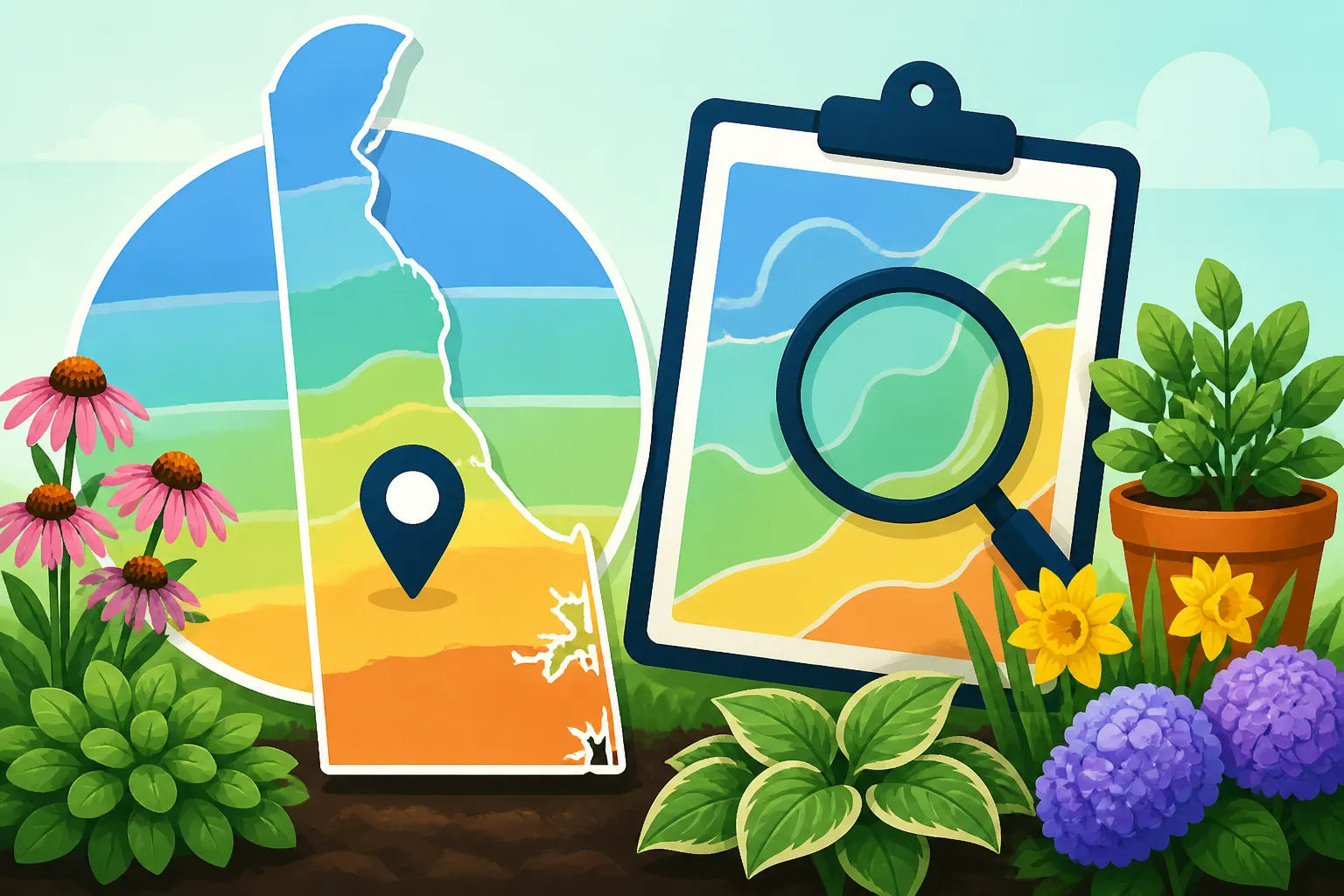
The USDA Plant Hardiness Zone Map provides a way to search for a location by ZIP code. Use the search as a starting point, then check the map around the result rather than treating the search label as a measurement of your entire property.
- Open the USDA Plant Hardiness Zone Map. Use the map’s location search to enter your Delaware ZIP code. Check that the location result is in Delaware and matches the community you intend to look up.
- Read the zone label shown for the searched location. Record the complete label, including its letter subdivision, rather than noting only the broader numbered zone.
- Zoom in and look around the result. The color near the searched location gives useful context. If nearby areas appear in different colors, your ZIP code may sit near a mapped transition, or local conditions may vary across the area.
- Check the map legend. Use the legend to confirm what the colors and zone subdivisions mean. Avoid estimating a zone based on color alone, especially on a small screen or a printed image.
- Compare the map with your actual site. Consider whether your yard is exposed, shaded, elevated, low-lying, close to water, or sheltered by buildings. Those details can matter even when the mapped zone is clear.
- Use the result alongside plant-specific information. Check the plant’s stated hardiness range and its needs for sun, soil, moisture, and summer conditions before buying or planting it.
If the map’s search result seems surprising, repeat the lookup and inspect the surrounding map. Confirm that you entered the right ZIP code and that the result is not a nearby community with a similar name. The goal is not to find a label that confirms a guess; it is to read the map result accurately and understand how limited that result is.
A postal ZIP code is designed for mail delivery, not to describe a uniform climate. It can cover a broad area, and the conditions at one end of it may differ from those at the other. A search result identifies a mapped location associated with the ZIP code; it does not assign one zone to every yard, street, or parcel within the postal area. Never assume a ZIP-code search can identify the exact growing conditions at a specific address.
If you want to see how location comparisons work across the state, Finding Your USDA Hardiness Zone Across Delaware Locations provides a related way to think about differences among Delaware areas. For a planting decision, though, it is still worth checking your own site and the needs of the specific plant.
Why ZIP codes do not define the whole yard
Even a small garden can contain more than one kind of growing environment. A sunny wall, a shaded side yard, and a low spot where cold air settles may be only a short walk apart, yet plants in those places can experience different conditions.
A ZIP-code result does not capture these yard-level variations. The map is useful at a regional scale, but it cannot account for a fence that blocks wind, a paved area that stores heat, or a slope that drains cold air. It also cannot describe how long a location stays wet after rain or how much sun a bed receives.
Microclimates around a home
A microclimate is a small area with conditions that differ from the broader area around it. In Delaware, as elsewhere, local conditions can be affected by:
- Building walls and pavement: Masonry and pavement can absorb heat during the day and release it later. A bed beside a building may be warmer than an exposed bed, but it may also receive reflected heat that stresses some plants.
- Wind exposure: An open site may dry out faster and expose plants to wind, while a protected courtyard can be less exposed. Shelter can help, but it does not remove the risk of a severe cold spell.
- Shade: A shaded spot may warm more slowly in spring and stay cooler during part of the day. That can suit some plants and delay others.
- Slopes and low spots: Cold air tends to move downhill and collect in low areas when conditions allow. A low pocket may experience colder conditions than a nearby slope.
- Nearby water and landscape features: Water, trees, walls, and other features can affect exposure and temperature, but the effect varies with the site.
These differences can help explain why one gardener has success with a plant while another nearby gardener struggles. They do not mean the map is wrong. The map is answering a broad question about winter minimum temperatures; it is not a detailed forecast for each planting bed.
To assess your yard, note where snow or frost tends to linger, which beds warm first in spring, where wind is strongest, and which areas remain damp after rain. Observations across more than one season are more useful than a single warm or cold week. Keep a simple garden record with the location of each plant and any repeated winter damage. That record can help guide future choices more effectively than repeatedly searching the same ZIP code.
For more on how to adapt planting decisions to sheltered and exposed locations, see Delaware Microclimates: Adjusting Dates for Cold Pockets and Cities. When your concern is a cold dip or frost rather than long-term plant survival, Why Spring Frost Still Strikes After Your Delaware Frost Date explains why a mapped zone or average frost date cannot guarantee frost-free weather.
What a zone lookup cannot tell you about planting dates
Hardiness zones and planting calendars answer different questions. A hardiness zone helps describe the winter cold a perennial plant may need to tolerate. A planting calendar helps you decide when to sow or transplant a crop based on seasonal conditions.
For example, a vegetable may grow well through Delaware’s warm season but be killed by winter cold. Its hardiness zone is not a useful way to choose the day to plant it outdoors. Conversely, a perennial may be hardy in a given area but still need careful planting, adequate drainage, and time to establish before winter.
A ZIP-code result does not tell you:
- when your last spring frost will occur;
- when the soil will be warm enough for a heat-loving crop;
- whether rain has made your garden soil workable;
- whether a late cold snap is forecast;
- how long a crop has to mature before fall cold arrives;
- whether a plant will tolerate a wet winter or summer heat.
This distinction is especially important when making decisions about tomatoes, peppers, cucumbers, squash, beans, and other tender crops. Their outdoor timing depends on the season and on conditions at planting time. A zone label alone cannot say whether seedlings are ready to go into the ground. For help separating the question of plant hardiness from the question of transplant timing, see Why Hardiness Zones Alone Cannot Dictate Your Planting Dates.
For vegetables, use a state-specific planting calendar and adjust it to the year’s conditions. Delaware Year-Round Vegetable Gardening Calendar can help organize crops across the seasons, while Delaware Cool-Season Vegetable Planting Guide focuses on crops that can be started in cooler weather. Warm-season crops need a different approach; Delaware Warm-Season Planting Calendar: Spring to Summer Windows covers that planning question.
Weather also varies from year to year. A typical spring pattern does not prevent a late frost, and a mild early spell does not mean that cold risk has passed. Check a current local forecast before planting or moving tender plants outdoors. If you are deciding whether a crop can be planted now, use a planting window as guidance rather than treating it as a fixed date.
How to use your zone when choosing plants
Use the ZIP-code result as a screening tool, not as a final verdict. Start by comparing the plant’s hardiness information with the map result, then consider the garden conditions the map does not cover.
Read the entire hardiness range
Plant labels and nursery descriptions may show a range of zones rather than one label. Look at the whole range and confirm that the map’s zone label falls within it. If your location appears near the plant’s cold limit, think carefully about exposure, winter protection, drainage, and how costly or difficult it would be to replace the plant if it does not survive.
A plant listed for a colder climate may generally tolerate a wider range of winter lows than one suited only to milder conditions. But hardiness is not the same as overall suitability. A plant can survive winter and still struggle with summer heat, humidity, soil pH, waterlogging, or inadequate light.
Check the plant’s other needs
Before choosing a plant, look beyond the zone label. Check:
- the amount and timing of sunlight it needs;
- whether it prefers dry, evenly moist, or wet soil;
- how well the site drains;
- its mature size and spacing needs;
- whether it tolerates Delaware’s summer conditions;
- whether it needs a pollination partner or another plant nearby;
- whether it is suited to a container or needs room in the ground.
For a tree, shrub, or perennial, compare the plant’s preferred conditions with the exact location where you plan to grow it. A correct zone match cannot make a poor site suitable. A shrub that needs sun may fail in deep shade even if its hardiness range matches the map. A plant that needs sharp drainage may decline in a soggy bed even if winter cold is not a concern.
Consider how established the plant will be
A newly planted perennial or woody plant may be more vulnerable than one that has been established for several seasons. Roots need time to grow into the surrounding soil, and drought, waterlogged ground, or an abrupt freeze can compound the stress of a new planting. Pay attention to the plant’s condition and follow appropriate planting and care guidance; do not rely on a zone label as a substitute for establishment care.
Container plants also need separate consideration. Roots in a pot are more exposed to temperature changes than roots in the ground, and a plant that is hardy in a garden bed may not overwinter as reliably in a small container. If you are choosing a plant for a pot, check guidance that specifically addresses container growing and winter care.
Use local performance as supporting evidence
Nearby gardens and local nurseries can help you understand how a plant performs in the region, but one successful planting is not proof that it will perform equally well in every yard. Ask what conditions the plant was grown in, including sun, soil, drainage, and winter exposure. A sheltered garden may produce different results from an open, windy site.
Keep notes about plants that survive and thrive in your own garden. Record where they are planted and whether they experience winter damage, delayed spring growth, or summer stress. Over time, this information helps you decide whether to repeat a plant, choose a more resilient alternative, or place it somewhere with better conditions.
How to interpret a result near a zone boundary
A map transition can make a ZIP-code lookup feel less certain. A searched location may sit near a boundary, or the map may show different zones in nearby areas. That does not automatically make the result unusable. It means you should avoid making a high-stakes decision based on the search label alone.
Begin by checking the exact location of the map result and the map legend. Then compare the surrounding area. If the searched point is close to a transition, treat the result as an estimate for the area rather than a precise rating for your yard. A broad ZIP code may include places with different exposures and local conditions, even if the map displays a single label for the searched location.
For a borderline plant choice, consider the consequences of failure. If the plant is inexpensive and easy to replace, you may decide to try it in a protected spot. If it is a long-lived tree, an expensive specimen, or a plant that would be difficult to replace, it may be wiser to choose one with a comfortable hardiness margin and a good fit for the site. Neither choice is automatically right; the important point is to recognize the uncertainty.
A useful way to evaluate a borderline choice is to ask:
- Is the plant’s hardiness range a close match, or is the local result near its limit?
- Is the proposed planting site sheltered or exposed?
- Does the soil drain well enough for the plant?
- Is the plant also suited to the site’s summer sun, moisture, and heat?
- Would you be comfortable replacing it if an unusually cold winter caused damage?
If the answer to several questions is uncertain, look for a better-matched plant or try the borderline plant in a small, lower-risk location first. Do not confuse a mild recent winter with proof that the next winter will be mild. Hardiness zones describe a long-term pattern, while each winter can bring conditions outside that pattern.
For statewide context, How to Check Your Delaware Hardiness Zone by Local ZIP Code is the specific topic of this page, while How to Check Your Delaware Hardiness Zone by Local ZIP Code should not be repeated as a link here. Instead, use How to Check Your Delaware Hardiness Zone by Local ZIP Code only when returning to this same topic is useful; because this is the current article, it is not linked again. When choosing plants across different parts of the state, How to Check Your Delaware Hardiness Zone by Local ZIP Code is not a substitute for comparing locations. The companion resource Finding Your USDA Hardiness Zone Across Delaware Locations can help frame those comparisons.
A practical way to use the lookup in your garden
The simplest approach is to separate the lookup from the planting decision. First identify the mapped zone associated with your ZIP code. Then evaluate the particular plant and garden bed. Finally, check the weather or seasonal guidance that applies to the immediate planting decision.
- Make a short list of plants you are considering. Include trees, shrubs, perennials, or vegetables, and note whether the goal is winter survival, a spring planting, or a harvest.
- Look up the ZIP code on the USDA Plant Hardiness Zone Map. Record the full result and inspect the surrounding map.
- Check each plant’s hardiness range. Confirm that the map result is compatible, but be cautious if the plant is at the edge of its stated range.
- Assess the planting site. Note sun, wind, slope, drainage, shade, and nearby pavement or buildings.
- Use a relevant seasonal resource. For vegetables, consult Delaware planting guidance rather than choosing a planting date from the zone result.
- Check current conditions before acting. For frost-sensitive plants, review the local forecast and soil conditions close to planting time.
- Keep a record. Write down what you planted, where it went, and how it performed through winter and summer.
This process is more useful than trying to find one perfect number for an entire ZIP code. A zone label is a helpful piece of information, but good plant selection comes from combining it with the plant’s requirements and the conditions where it will grow.
If your main question is how to start a vegetable garden rather than how to select perennial plants, Delaware Beginner Gardening: What to Grow and When to Start offers a broader starting point. For a plant-specific timing question, use a crop guide that matches the plant and season. Hardiness is one factor in a planting decision, not a calendar for every task.
Frequently Asked Questions
Can I use my ZIP code to find my exact hardiness zone?
A ZIP-code search can give you a useful map result, but it cannot determine the exact conditions of every yard within that ZIP code. Check the result on the USDA Plant Hardiness Zone Map and consider local exposure, slope, drainage, and nearby buildings.
Does my hardiness zone tell me when to plant tomatoes?
No. The zone describes average annual extreme minimum winter temperatures. Tomato planting depends on seasonal frost risk, soil warmth, and weather at the time you plan to transplant. Use Delaware planting guidance and check the forecast.
If a plant is rated for my zone, will it definitely survive?
No. A matching hardiness range is a useful screening point, not a guarantee. Plant health also depends on soil, drainage, moisture, light, summer conditions, exposure, and how well the plant establishes.
Why can two gardens in the same ZIP code have different results?
Gardens can differ in wind, shade, slope, drainage, reflected heat, and shelter from buildings or trees. Those local conditions can affect plant survival and growth even when the gardens share a ZIP code and a map result.
Disclaimer
This article is for general informational purposes only and does not constitute professional advice. Laws, prices and regulations vary by location and change over time. Consult a qualified professional for guidance on your specific situation. Delaware Gardening Guide is not a government agency and is not affiliated with any university extension, state department of agriculture or other government agency.